Introduction
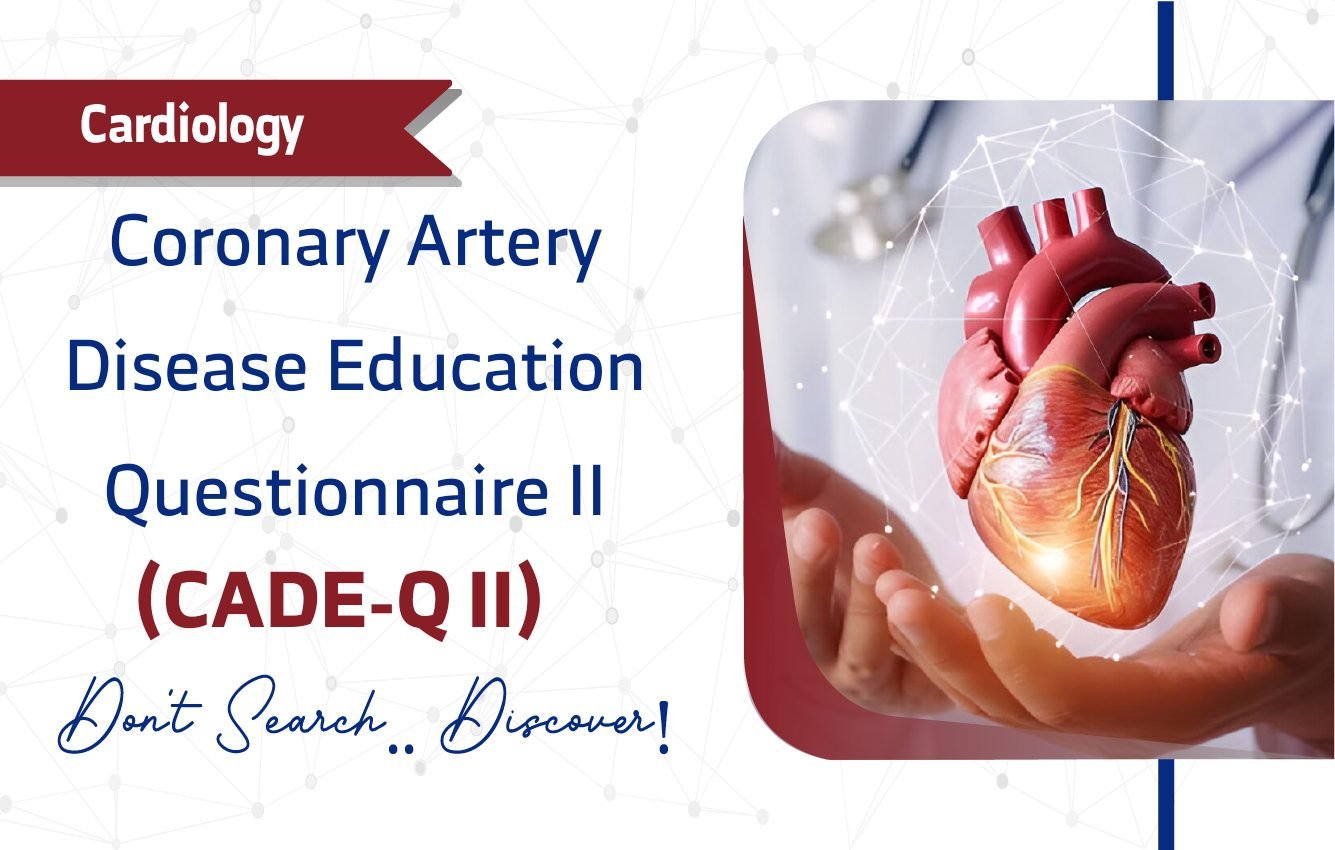
The Coronary Artery Disease Education Questionnaire – Second Version (CADE-Q II) serves as an essential tool for clinicians and researchers working in cardiology. Developed to address gaps in patient education, this 31-item questionnaire measures knowledge levels related to coronary artery disease (CAD). With over 60 citations in scientific literature, the CADE-Q II effectively identifies educational needs that directly influence treatment adherence and long-term outcomes. Consequently, Consequently, health professionals rely on this questionnaire to support targeted interventions in diverse cardiac rehabilitation settings.
Therefore, this article explores the CADE-Q II’s structure, applications, psychometric properties, and practical value for researchers and healthcare professionals.
Key Features of the Coronary Artery Disease Education Questionnaire II (CADE-Q II)
Purpose and Use
Overall, the primary purpose of the CADE-Q II is to systematically assess patients’ knowledge about coronary artery disease (CAD). Educational status directly influences how well an individual manages cardiovascular risks; therefore, this questionnaire serves as a diagnostic tool for tracking educational needs. By deploying the CADE-Q II, clinical teams can pinpoint exactly which health concepts require further explanation.
Target Population
The CADE-Q II is thoroughly validated for adults aged 18 years and older. Consequently, the instrument is highly suitable for a wide demographic range, including:
- Young Adults (18–24 years)
- Middle-Aged Adults (25–44 years)
- Older Adults (45–64 years)
- Older People (65+ years)
Moreover, the authors explicitly designed the tool for adults who have received a definitive diagnosis of Coronary Artery Disease.
Structure
Importantly, the questionnaire features a robust structure containing 31 items. These items evaluate a patient’s understanding of CAD symptoms alongside specific lifestyle modifications. To provide a nuanced assessment, the authors divided the 31 items across five distinct subscales:
- Medical Condition: Understanding the pathology and clinical signs of CAD.
- Risk Factors: Identifying lifestyle and genetic components that aggravate heart disease.
- Exercise: Knowledge regarding safe physical activity and cardiac rehabilitation guidance.
- Nutrition: Comprehending dietary habits that support cardiovascular health.
- Psychosocial Risk: Recognizing how stress, anxiety, and depression affect heart health.
Scoring Method
The CADE-Q II utilizes a straightforward multiple-choice format where each of the 31 items contains exactly one correct answer. For scoring purposes, evaluators code responses as follows:
- 1 for a correct answer
- 0 for an incorrect answer
Therefore, researchers sum all individual item scores to yield a final total score ranging from 0 to 31. Higher overall scores indicate a greater knowledge of coronary artery disease.
In addition to the total score, researchers can calculate individual subscale scores by summing the correct responses within each of the five specific subdomains. Notably, formal cut-off scores do not exist for this tool.
Administration Format
The CADE-Q II operates as a self-administered and flexible instrument. Healthcare teams can easily deliver the questionnaire via multiple channels:
- Paper-based formats
- Digital (online)
- In-person interview
- Phone/Video call
Moreover, completion typically takes 10-15 minutes, making it highly practical for busy clinical and research environments.
Applications of the Coronary Artery Disease Education Questionnaire II (CADE-Q II)
Notably, the CADE-Q II exhibits significant clinical utility across several healthcare sectors:
- Screening: It works effectively to screen and identify baseline knowledge deficiencies in cardiac patients.
- Monitoring: Clinicians can monitor educational progress throughout a multi-week cardiac rehabilitation program.
- Research: It serves as a validated endpoint in health literacy and cardiovascular outcomes research.
Languages and availability
To facilitate international research, the CADE-Q II is accessible in several languages, including:
- English
- Mandarin Chinese
- Russian
- Portuguese
Therefore, more importantly, this multilingual support facilitates international research and multicultural clinical applications.
Reliability and Validity
Notably, psychometric evaluations indicate that the CADE-Q II is a moderately reliable and valid instrument. It demonstrates an acceptable internal consistency, evidenced by a Cronbach’s alpha of 0.70. Accordingly, researchers can confidently implement the questionnaire in diverse clinical trials and tracking studies.
Moreover, validation teams have successfully adapted and validated the tool in several regional languages:
Limitations and Considerations
Despite its strengths, the CADE-Q II has a few limitations:
- Self-Report Measure: Because the questionnaire relies entirely on self-reporting, the collected data reflects the patient’s subjective understanding and may not always align perfectly with their objective behavioral compliance.
- Social Desirability Bias: Respondents may consciously or unconsciously choose answers they believe the healthcare team expects or desires, rather than reporting their actual habits or knowledge gaps.
- Length: Though highly comprehensive, the 31-item structure may feel quite lengthy for certain patient populations, potentially leading to cognitive fatigue or incomplete forms during busy clinical sessions.
- Cultural Bias: The conceptual understanding of certain lifestyle factors, dietary recommendations, and psychosocial elements can vary significantly across different populations, which may impact how specific items are interpreted.
- Language Barriers: While several official translations exist, administering the tool in a language or cultural context that has not undergone rigorous cross-cultural validation can compromise the accuracy and reliability of the data.
- Age Restrictions: The CADE-Q II is strictly validated and designed for adults aged 18 and older, meaning it is not suitable or calibrated for pediatric populations or adolescent cardiac patients.
Other Versions And Related Questionnaires
In addition to the full 31-item version, a shorter adaptation exists:
- Coronary Artery Disease Education Questionnaire – Short Version (CADE-Q-SV)
Moreover, depending on the specific study goals, the tool can be paired with or compared against related instruments, including:
- Coronary Artery Disease Education Questionnaire (CADE-Q original version)
- Heart Disease Fact Questionnaire (HDFQ)
- Cardiovascular Disease Risk Factors Knowledge Level Scale (CARRF-KL)
- Self-Care of Coronary Heart Disease Inventory (SC-CHDI)
Additional Resources
- The Original Validation Study link
- You can access the questionnaire as a PDF here: Link
- For inquiries, contact Gabriela Lima de Melo Ghisi at Gabriela.ghisi@gmail.com
Frequently Asked Questions (FAQ)
- Who can use the CADE-Q II?
Clinicians, researchers, and cardiac rehabilitation specialists use the CADE-Q II to assess health literacy in adult patients aged 18 and older who have been diagnosed with Coronary Artery Disease (CAD).
- How long does it take to complete the CADE-Q II?
Patients typically take 10 to 15 minutes to complete the questionnaire, making it a highly practical tool for busy clinical settings and longitudinal research studies.
- How is the CADE-Q II administered?
The tool is designed to be self-administered, offering clinical teams great logistical flexibility. It can be completed via paper-based forms, digital (online) platforms, in-person interviews, or over phone and video calls.
- Is there any cost associated with using the CADE-Q II?
No, the CADE-Q II is free to use under an Open Access model, meaning researchers and healthcare providers can utilize it without incurring licensing fees.
A Word From ResRef about the Coronary Artery Disease Education Questionnaire II (CADE-Q II)
Overall, the CADE-Q II is a validated 31-item questionnaire developed to assess knowledge of coronary artery disease across five domains. It is widely used in cardiac Rehabilitation to identify knowledge gaps and guide patient education strategies.
References
- Ghisi, G. L. D. M., Grace, S. L., Thomas, S., Evans, M. F., & Oh, P.. (2015). Development and psychometric validation of the second version of the coronary artery disease education questionnaire (cade-q ii). Patient Education And Counseling, 98(3), 378-383. Link
- Chen, Z., Geng, J., Wang, M., Hu, L., Ghisi, G. L., & Yu, H.. (2018). The chinese version of the coronary artery disease education questionnaire-ii (cadeq-ii): translation and validation. Patient Preference And Adherence, Volume 12, 1587-1596. Link
- Laskova, A. I., Ghisi, G. L. M., & Lopatin, Y. M.. (2022). Translation, cross-cultural adaptation, and psychometric validation of the russian coronary artery disease education questionnaire ii (cade-q ii) in chronic coronary syndrome patients. Russian Journal Of Cardiology, 27(6), 5049. Link
- Santos, R. Z. D., Ghisi, G. L. M., Bonin, C. D. B., Chaves, G., Haase, C. M., Britto, R. R., & Benetti, M.. (2018). Validation of the brazilian version of cade-q ii to assess knowledge of coronary artery disease patients. Arquivos Brasileiros De Cardiologia, . Link