Introduction
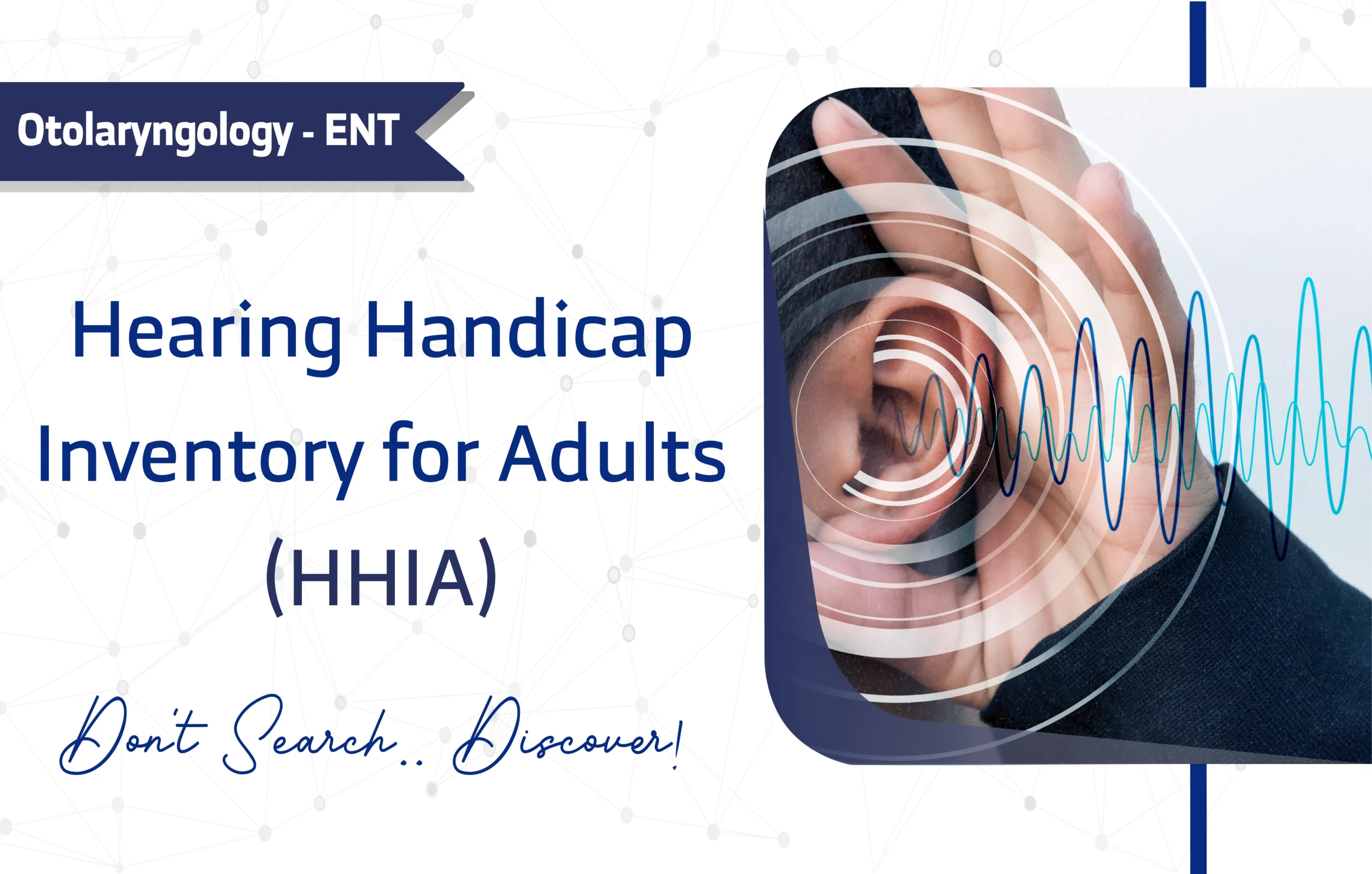
The Hearing Handicap Inventory for Adults (HHIA) is a cornerstone self-assessment tool in audiology and psychology, meticulously designed to quantify the perceived problems a patient experiences as a result of hearing loss. Newman, Weinstein, Jacobson, and Hug developed this questionnaire in 1990. Therefore, this tool moves beyond objective audiometric data to capture the real-world impact of hearing impairment. Moreover, researchers have cited its significance as a research and clinical instrument over 800 times, thus establishing its value well.
Consequently, this article explores the HHIA’s features, scoring, applications, and psychometric properties comprehensively.
Key Features of the Hearing Handicap Inventory for Adults (HHIA)
Purpose and Use
The primary purpose of the HHIA is to identify and measure the psychosocial consequences of hearing loss. Crucially, unlike objective tests that measure auditory function, the HHIA quantifies the patient’s subjective experience of handicap. Specifically, it assesses hearing-related quality of life. Thus, it remains an invaluable tool for understanding the emotional distress and social limitations that patients face.
Target Population
The HHIA is specifically designed for:
- Young Adults (18-24 years).
- Middle-Aged Adults (25-44 years).
- Older Adults (45-64 years).
This focus distinguishes it from its well-known counterpart, the Hearing Handicap Inventory for the Elderly (HHIE), which is intended for seniors. Thus, researchers studying a working-age adult population will always find the HHIA to be the appropriate instrument.
Structure
The questionnaire consists of 25 items. These items are intelligently divided into two subscales to provide a detailed profile of the patient’s handicap:
- Social/Situational Subscale (12 items): This section measures perceived difficulties in social interactions and everyday communication situations, such as group conversations or using the telephone.
- Emotional Subscale (13 items): This section measures affective responses to hearing loss, such as feelings of frustration, embarrassment, distress, or being handicapped.
Scoring Method
The HHIA employs a simple and intuitive 3-point multiple-choice response format. In other words, each of the 25 questions is answered with “YES,” “SOMETIMES,” or “NO,” which are scored numerically:
- YES = 4 points
- SOMETIMES = 2 points
- NO = 0 points
From these responses, consequently, both subscale and total scores are calculated. Specifically, The total HHIA score is the sum of both subscales, with a maximum possible score of 100 points. Furthermore, The individual subscale maximums are 48 for the Social/Situational scale and 52 for the Emotional scale.
The total score is interpreted to reflect the perceived degree of handicap:
- 0–17 points: No significant handicap.
- 18–42 points: Mild to moderate handicap.
- 43–100 points: Significant handicap.
Administration Format
The HHIA is designed for efficiency and flexibility. Indeed, it typically takes only 5-10 minutes to complete. Furthermore, it is a self-administered tool, which means meaning no special training is required for its administration.
Furthermore, it supports all administration formats, including:
- Paper-based.
- Digital (online).
- Mobile App.
- Interview (in-person).
- Phone/Video call.
Making it highly adaptable for various research protocols and clinical workflows.
Applications of the Hearing Handicap Inventory for Adults (HHIA)
The HHIA serves several critical functions in both clinical practice and audiological research:
- Screening: Ultimately, it is an effective tool for screening adults to identify the perceived level of hearing handicap, thereby complementing objective audiometric tests.
- Monitoring: The questionnaire can be used to longitudinally monitor a patient’s perceived handicap, allowing clinicians and researchers to track changes over time or measure the effectiveness of interventions (e.g., hearing aids).
- Research: Indeed, as a robust and highly cited measure, the HHIA is a standard instrument in studies focusing on hearing-related quality of life, the psychosocial impacts of hearing loss, and the outcomes of audiological rehabilitation.
Language and availability
A major strength of the HHIA is its broad international applicability. It has been translated and validated in numerous languages, including:
- English
- Arabic.
- Spanish.
- Portuguese.
- Hindi.
- others.
The HHIA is free for non-commercial clinical and research use. However, Although it is free for these purposes, it is a proprietary instrument published by Lippincott Williams & Wilkins. Consequently, commercial use would require appropriate licensing.
Reliability and Validity
The HHIA is recognized as a highly reliable and valid instrument.
In support of this, the scale demonstrates excellent internal consistency, with a Cronbach’s alpha of 0.93 for the total scale. Furthermore, the subscales are also strong, with an alpha of 0.88 for the emotional subscale and 0.85 for the social/situational subscale.
Limitations and Considerations
Despite its widespread use, researchers should be aware of a few limitations:
- Self-Report Measure: As a self-report tool, scores are based on the patient’s subjective perception and may be influenced by factors other than their hearing loss (e.g., mood, personality).
- Cultural Bias: While many translations exist, researchers must ensure they are using a culturally validated version, as perceptions of “handicap” can vary.
- Age Restrictions: The HHIA is specifically for adults 18-64 and is not appropriate for pediatric or elderly populations (for whom the HHIE is used).
- No Universal Cut-off: Although interpretive bands are provided, there are no universally accepted cut-off scores for diagnosis or treatment qualification.
Other Versions And Related Questionnaires
It is crucial to select the correct version for your population. The HHIA is one of three main versions:
- The Hearing Handicap Inventory for the Elderly (HHIE).
- Hearing Handicap Inventory – Screening Version (HHIE-S).
- Hearing Handicap Inventory for Adults (HHIA-S).
The HHIA can be complemented by other tools, such as:
- The Abbreviated Profile of Hearing Aid Benefit (APHAB).
- The Client-Oriented Scale of Improvement (COSI).
- The International Outcome Inventory for Hearing Aids (IOI-HA).
Additional Resources
For more information on the HHIA and to access the full questionnaire, please consult the following resources:
- Original Validation Study link.
- Questionnaire Access: A PDF of the questionnaire can be accessed through this link.
- For Inquiries: Contact the publisher, Lippincott Williams & Wilkins, for licensing or commercial use questions.
Frequently Asked Questions (FAQ)
- Who can use the HHIA?
Clinicians (audiologists, ENTs), researchers, and healthcare providers use the HHIA for adult patients aged 18-64 to assess the perceived psychosocial handicap of hearing loss.
- How long does it take to complete the HHIA?
Patients typically take 5 to 10 minutes to complete the 25-item questionnaire, which makes it feasible for use in clinical and research settings.
- How is the HHIA administered?
Healthcare teams can administer the HHIA via paper, digital, or interview formats, offering significant flexibility in usage. It is designed to be self-administered.
- Is there any cost to using the HHIA?
The HHIA is free for non-commercial clinical and research use. However, it is a proprietary instrument, and commercial use requires permission from the publisher.
A word from ResRef about The Hearing Handicap Inventory for Adults (HHIA)
The Hearing Handicap Inventory for Adults (HHIA) is a reliable self-assessment tool primarily designed to evaluate the emotional and social effects of hearing loss in adults. Specifically, it complements objective audiometric tests by capturing the perceived impact of hearing difficulties on daily life and communication.
References
- Newman CW, Weinstein BE, Jacobson GP, Hug GA. The Hearing Handicap Inventory for Adults: psychometric adequacy and audiometric correlates. Ear Hear. 1990 Dec;11(6):430-3. Link.
- Carrillo A, Medina MDM, Polo R, Alonso D, Vaca M, Muriel A, Fernandez B, Rivera T, Cobeta I. Validation of the Hearing Handicap Inventory for Adults Scale for Spanish-Speaking Patients. Otol Neurotol. 2019 Dec;40(10):e947-e954. Link.
- ryal S, Bhattarai B, Prabhu P. Development and Standardization of Hearing Handicap Inventory for Adult (Screening Version) in Nepali Language. Indian J Otolaryngol Head Neck Surg. 2022 Dec;74(Suppl 3):4409-4414. Link.
- Zam Zam TZHBT, Dzulkarnain AAA, Rahmat S, Jusoh M. Translation, Adaptation and Cross-Cultural Validation of Hearing Handicap Inventory for Adult in Malay Language. J Audiol Otol. 2019 Jul;23(3):129-134. Link.
- Aiello CP, de Lima II, Ferrari DV. Validity and reliability of the hearing handicap inventory for adults. Braz J Otorhinolaryngol. 2011 Jul-Aug;77(4):432-438. Link.
- Alqudah S, Zaitoun M, Almomani F, Alshdifat K, Alhanada M. Adaptation of the Arabic versions of the Hearing Handicap Inventory for adults and elderly with permanent sensorineural hearing loss. Int J Audiol. 2020 Nov;59(11):818-822. Link.
- Monzani D, Genovese E, Palma S, Rovatti V, Borgonzoni M, Martini A. Measuring the psychosocial consequences of hearing loss in a working adult population: focus on validity and reliability of the Italian translation of the hearing handicap inventory. Acta Otorhinolaryngol Ital. 2007 Aug;27(4):186-91. Link.
- Folmer RL, Vachhani J, McMillan GP, Watson C, Kidd GR, Feeney MP. Validation of a Computer-Administered Version of the Digits-in-Noise Test for Hearing Screening in the United States. J Am Acad Audiol. 2017 Feb;28(2):161-169. Link.