Mastering Clarity and Conciseness in Scientific Writing

0
0 out of 5 stars (based on 0 reviews)

Table of Contents

Overview

Good research can lose its impact if the writing is unclear. Effective scientific writing communicates complex ideas simply and accurately. This article will help you master clarity, avoid common pitfalls, and polish your manuscript like a professional researcher.

Clarity and Conciseness in Scientific Writing

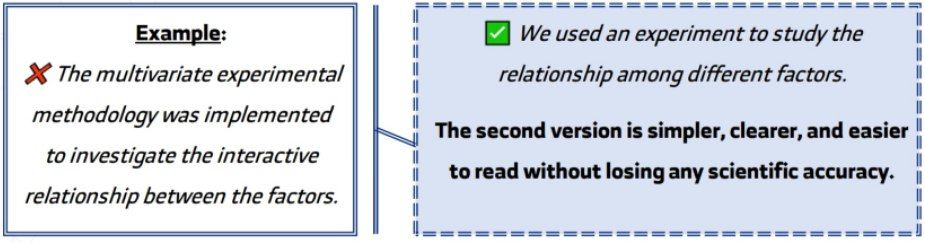
Clear and concise writing is the foundation of every successful scientific paper. Even a brilliant idea can lose its impact if it is buried under complex sentences or unnecessary jargon.

The goal is to help readers grasp your message quickly and effortlessly, even if they are not specialists in your exact field.


1. Use Simple Language and Avoid Excessive Jargon
Many researchers believe that using complex terminology makes their writing appear more professional. In reality, the opposite is true, the simpler your language, the stronger and more impactful your message.

 

2. Keep Sentences and Paragraphs Focused and Direct
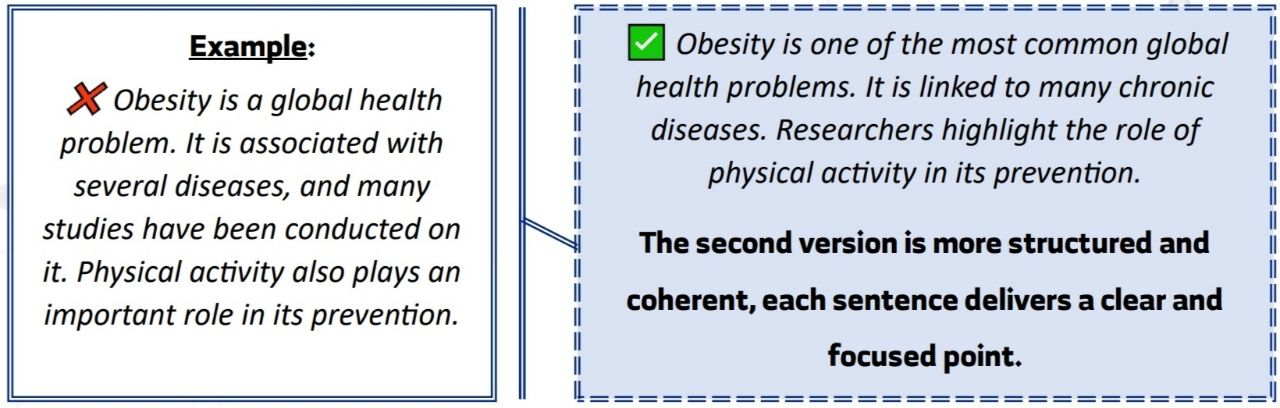
Each sentence should communicate a single idea, and each paragraph should revolve around one central point. Avoid unnecessary repetition or mixing unrelated ideas in the same paragraph, this confuses the reader and weakens your scientific message.
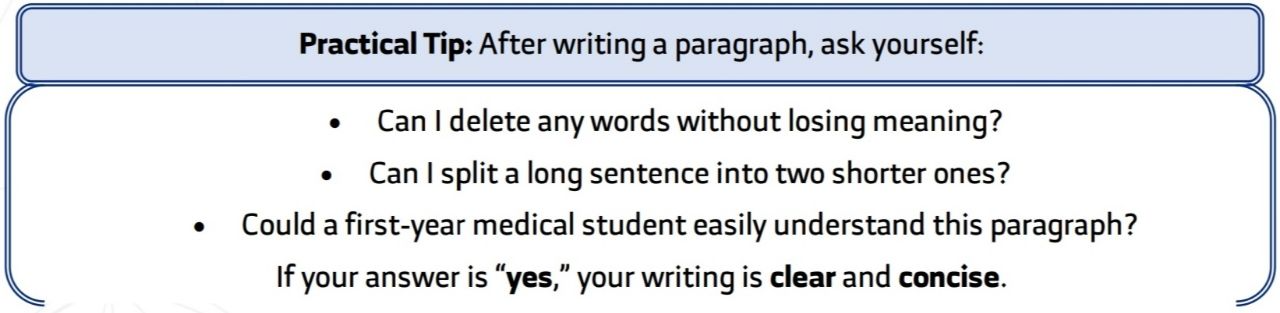
 

Common Writing Pitfalls

Even experienced researchers can fall into traps that weaken the clarity or credibility of their writing. The most frequent issues are ambiguity, contradiction, grammatical errors, and loss of a professional scientific tone.

 

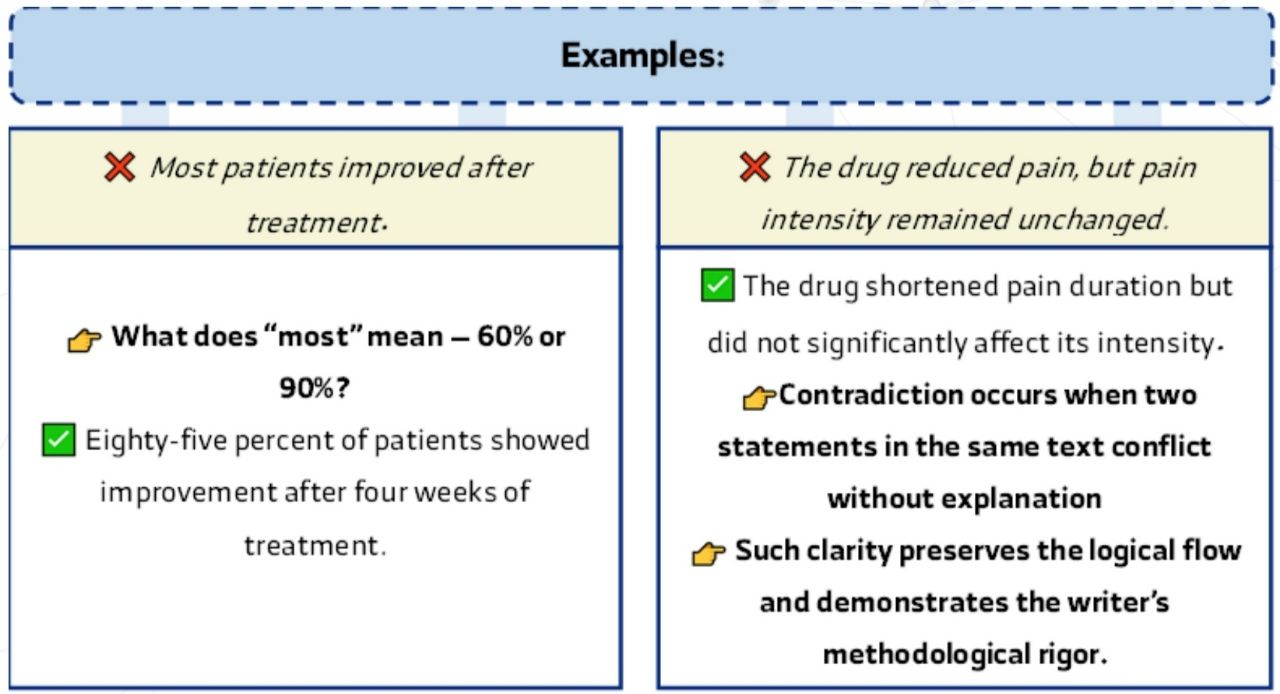
1. Avoid Ambiguity and Contradiction
Ambiguous statements leave readers uncertain about your exact meaning. In scientific writing, precision is key. Be specific and support your statements with numbers or evidence, not vague language.
 

2. Ensure Proper Grammar and a Scientific Tone
Even minor grammatical mistakes can negatively affect how readers perceive your research. Always review verb tenses, subject–verb agreement, and sentence structure carefully.

 

Research Note:

Ambiguity and contradiction are among the top reasons research papers are rejected by peer-reviewed journals.
To prevent this:

  • Proofread your text multiple times.
  • Ask a colleague or mentor to read your draft critically, fresh eyes often detect inconsistencies you may miss.

Active vs. Passive Voice

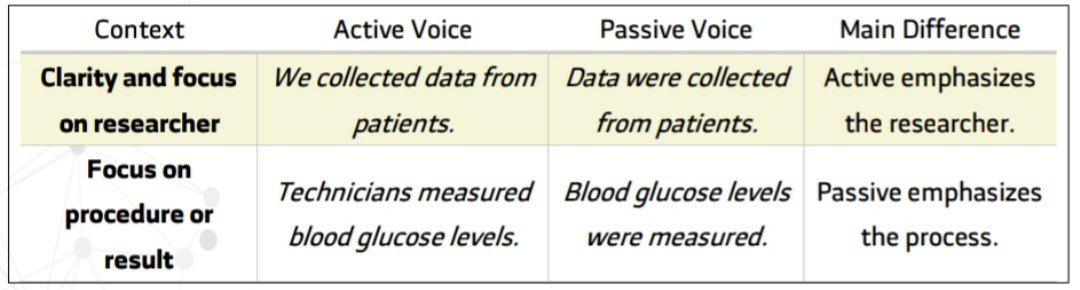
The choice between active and passive voice directly influences clarity and readability.

Active Voice

In active constructions, the subject performs the action. This structure improves readability and makes your sentences more dynamic, examples:

  • We analysed the data using SPSS.

  • The team collected samples from 50 patients.

Use active voice when:

  • Explaining your methods or actions in the Introduction or Discussion.
  • Describing what your research group did.
  • Highlighting responsibility or analytical reasoning.

Passive Voice

In passive constructions, the focus is on the process or outcome, not the actor.
This is particularly appropriate when the doer is either unknown, irrelevant, or implied, examples:

  • Samples were analysed using SPSS.

  • The study was conducted in the Department of Surgery.

Use passive voice when:

  • Writing the Methods section (the procedure is more important than the performer).
  • Presenting Results or standard procedures.
  • The actor is obvious or not relevant to the context.

Quick Comparison


 Practical Tip:

The best scientific writing balances both voices:

  • Use active voice for clarity and engagement.
  • Use passive voice for objectivity and process description.

Quick rule:

  • If your sentence starts with We, The team, The researchersActive.
  • If it starts with Was, Were, Performed, Analysed Passive.

Citation and Reference Best Practices

Proper citation is the backbone of scientific integrity. It establishes credibility, acknowledges prior work, and allows readers to verify your sources.
Good writers don’t just present ideas — they support them with evidence from reliable studies.

 

1. Cite Sources to Support and Credit Ideas
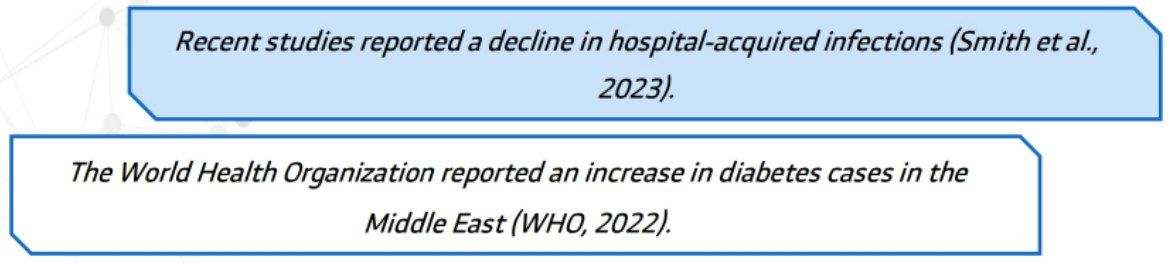
Whenever you present information, data, or an idea that is not originally yours, cite the source.
Citations demonstrate intellectual honesty and strengthen your argument.

Examples:
Important tips:

  • Never include data or claims without a source.
  • Use peer-reviewed journals or official reports.
  • Distinguish between direct quotation (exact wording) and paraphrasing (rephrasing ideas).

2. Use Reference Management Tools for Accuracy
Manually formatting references can be tedious and error-prone. Instead, use reference management software such as:

These tools help you:

  • Store all references in one database.
  • Insert citations into your document easily.
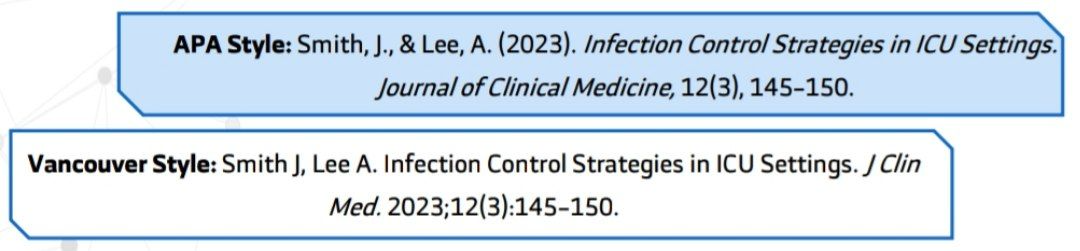
  • Automatically switch citation styles (APA, Vancouver, Harvard, etc.).
  • Generate a formatted reference list with one click.

Example:
 

 Research Note:

  • Choose one citation style and use it consistently, citation and reference styles may vary depending on the journal’s submission guidelines.
  • Verify that all in-text citations appear in the reference list.
  • Update your references regularly, outdated sources weaken your research.

Revising and Proofreading

Even the best researchers make mistakes in their first drafts. The secret to strong writing lies in careful revision and thoughtful editing.
Good editing transforms a rough draft into a polished, coherent, and reader-friendly manuscript.


Benefits:

1. Self-Editing Techniques
Self-editing means reviewing your own work critically before submitting it.
It’s not just about checking grammar — it’s about improving logic, structure, and flow.


Effective Techniques:

  1. Read aloud: Hearing the text helps you identify awkward phrasing or overly long sentences.
  2. Review paragraphs in reverse order: Start from the end to focus on language rather than content.
  3. Separate editing stages: Revise for grammar, then logic, then citations — not all at once.
  4. Check for flow: Ask yourself:
    • Does each paragraph support the main idea?
    • Are transitions smooth and logical?

2. Peer Feedback
After revising on your own, ask a colleague or supervisor to review your draft.
A fresh reader can detect unclear sections or inconsistencies you may overlook.


Benefits:

Example:
A colleague might say, “Your results are clear, but the connection to the discussion is weak.”
This type of feedback strengthens your argument and improves the paper’s overall flow.

Practical Tip:

  • After each round of editing, let the paper rest for at least one day before revisiting it.
  • Use AI-assisted grammar tools like Grammarly or LanguageTool — but never rely on them entirely.
    Technology can assist, but only human judgment ensures scientific accuracy and coherence.

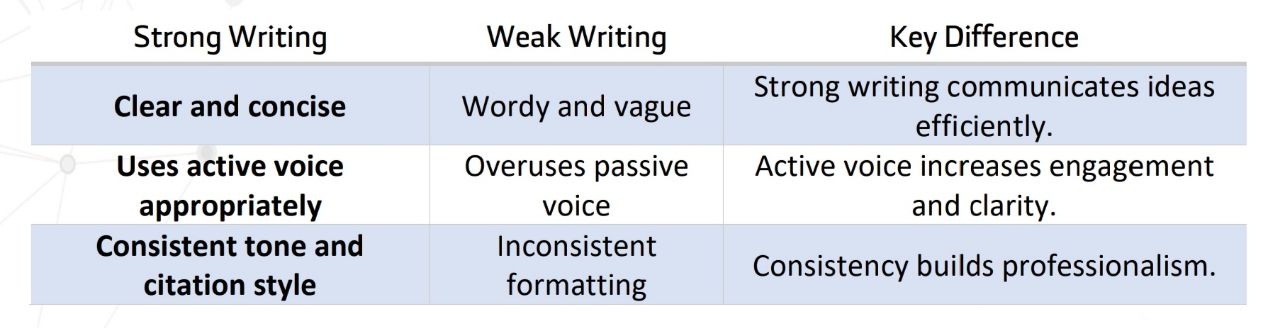
Comparison Table


Common Mistakes

  • Using overly complex language to “sound scientific”
  • Repeating ideas across sections
  • Ignoring proofreading before submission
  • Forgetting to cite secondary sources
  • Mixing tenses or citation styles            

Key Takeaways

  • Keep your writing clear, concise, and specific.

  • Use active voice for impact and passive voice strategically.

  • Maintain a consistent, professional tone.

  • Cite accurately and use reference tools.

  • Always revise and seek feedback before submission.

A Word From ResRef

Before you submit your next manuscript, pause and ask yourself a few simple questions: Is my message clear? Can a reader understand my main idea quickly? Have I removed unnecessary words or jargon? Strong scientific writing is not about sounding complicated, it is about communicating ideas effectively.
Focus on one idea per sentence, keep paragraphs centered on a single point, and support your statements with clear evidence. Use active voice when clarity matters, passive voice when the process is more important, and always maintain a professional and objective tone.
Finally, remember that good writing is rarely perfect in the first draft. Revise your work carefully, read it aloud, and invite a colleague to review it. A well-edited manuscript not only improves readability but also strengthens the credibility and impact of your research.
Clear writing helps good science reach the audience it deserves.

Frequently Asked Questions (FAQs)

1. How can I tell if my scientific writing is clear enough?
A simple test is to ask: Could a first-year student in my field understand this paragraph? If not, the sentence may be too complex or contain unnecessary jargon.

2. Is it okay to use simple language in scientific writing?
Yes. Clear and simple language is preferred. Using overly complex terminology does not make a paper more scientific—it often makes it harder to understand.

3. What is the best way to improve my manuscript before submission?
Revise your draft multiple times, read it aloud, and ask a colleague or mentor to review it. Fresh readers often detect unclear sections that the author misses.

4. Can AI grammar tools replace human proofreading?
No. AI tools can help detect language errors, but human judgment is essential to ensure scientific accuracy, logic, and coherence.

References

  1. Day, R. A., & Gastel, B. (2012). How to Write and Publish a Scientific Paper. Cambridge University Press.
  2. Glasman-Deal, H. (2020). Science Research Writing for Non-Native Speakers of English. Imperial College Press.
  3. Peat, J., & Barton, B. (2013). Scientific Writing: Easy When You Know How. BMJ Books.

Authorship and Contributions

The following section acknowledges the individuals who contributed to the authorship, editing, translation, and preparation of this article, ensuring its academic integrity and clarity.

Dr. Lama Aladel

Dr. Lama Aladal

Author

Senior Resident in Orthopedic Surgery

photo_٢٠٢٦-٠٣-١٢_١٦-٥٧-١٠

Dr. Eman Khashaneh

Editor

Neurologist with an MSc from Damascus University.

photo_٢٠٢٦-٠٣-١٢_١٣-٤٠-٣٧

Dr. Marie Noelle Seif Asskar

Translator & Formatter

A third-year medical student at the Faculty of Medicine, Latakia University, contributes to the Educational and Web departments at ResRef.
Facebook
Telegram
LinkedIn
Email

Leave a Comment

Your email address will not be published. Required fields are marked *

There are no reviews yet. Be the first one to write one.

Realted Articles

Mastering Research

Mastering Clarity and Conciseness in Scientific Writing

Discover how to master clarity and conciseness in scientific writing. Learn to use simple language, balance active and passive voice, avoid ambiguity, cite properly, and revise effectively to make your research papers more impactful and professional.

Read More »
IMRaD Model
Mastering Research

Scientific Writing Using the IMRaD Model: A Practical Guide for Researchers

Scientific writing is more than reporting results, it is about telling a clear, structured story of discovery. This article explains Scientific Writing Using the IMRaD Model, guiding researchers through each section of a scientific paper, from crafting effective titles and abstracts to presenting methods, results, and discussion with clarity and precision.

Read More »
Scroll to Top