





Understanding Cross-Sectional Studies

Table of Contents

Overview

In medical research, cross-sectional studies provide a quick and powerful way to understand what is happening in the present. They help researchers capture a snapshot in time, measuring both exposure and outcome simultaneously. These studies are often used to measure prevalence, explore associations, and generate hypotheses for future research. Whether you’re a medical student, clinician, or early-career researcher, understanding this study design is a must for mastering evidence-based medicine. In this article, we’ll break down how cross‑sectional studies work, when to use them, their strengths and limitations, and how they differ from longitudinal designs. We’ll also discuss where they stand in the hierarchy of evidence and how they are typically structured.

Definition and Characteristics of Cross-Sectional Studies

A cross‑sectional study is an observational study in which you measure both the exposure (risk factor or determinant) and the outcome (disease, condition, behaviour) at the same time point in a defined population. It is like taking a photograph of a group of people and recording what they have and what they are exposed to at that moment. You may refer to this study as a practical illustration.

  • Conducted at a single point in time.
  • Measures exposure and outcome together.
  • Often designed for estimating prevalence (how many people have X) and for exploring associations.
  • Often uses questionnaires or health surveys.

In fact, most cross-sectional studies are based on structured questionnaires. Each questionnaire helps researchers capture participants’ current characteristics, behaviours, or health status. The more validated questionnaires you include, the broader and clearer your understanding of the target population becomes. Many such tools can be accessed through resources like our website ResRef database, which provides standardised and validated research instruments.

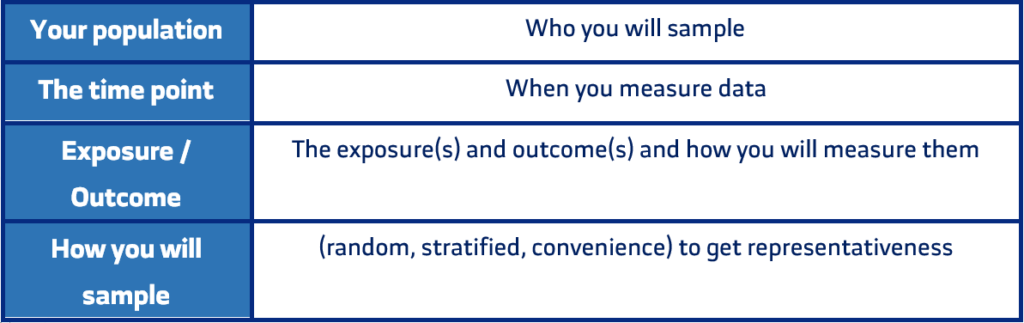
When you plan a cross-sectional study, clearly define:

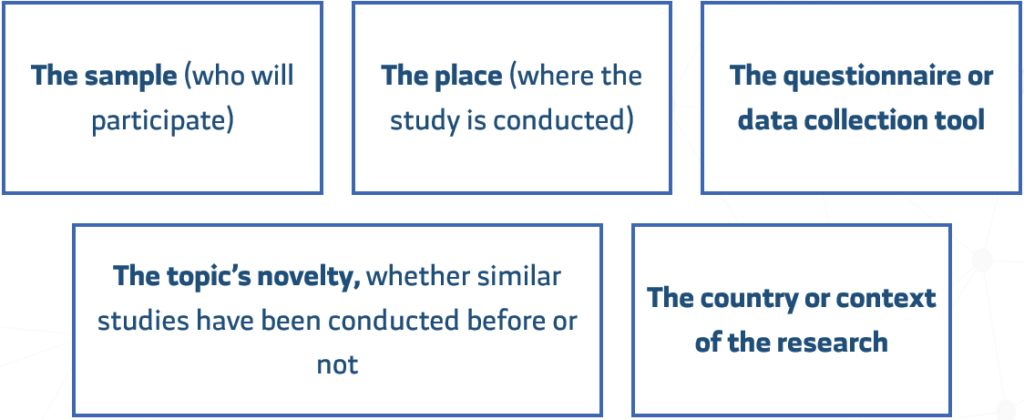
A simple way to think of a cross-sectional idea is that it consists of several key components:

Changing any of these elements (for example, using a different population, country, or questionnaire) can result in a new study idea. This process also helps you identify research gaps by assessing whether the topic has already been explored in a similar sample or setting.

These steps will help you get valid prevalence estimates and meaningful associations.

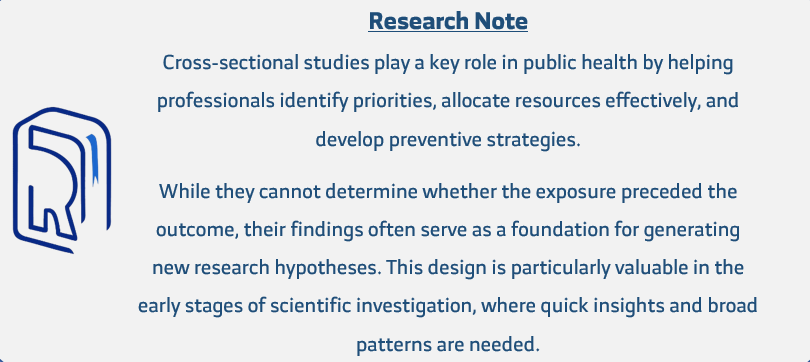
In the hierarchy of scientific evidence, cross-sectional studies are generally positioned below randomised controlled trials and cohort studies but above case reports and expert opinions. They provide descriptive and analytical insights that are crucial in the early stages of research, especially when exploring new topics or generating hypotheses. While they do not establish causality, they offer foundational data that can guide more advanced longitudinal or experimental designs.

For further information about the Hierarchy of Evidence please visit our third article “From Idea to Design: A Simple Guide to Choosing Your Research Methodology.”

Objectives of Cross-Sectional Studies

Cross‑sectional studies serve two main purposes in medical research:

  1. Estimate prevalence: determine the proportion of a population having a disease or attribute at that time.
    Example: Determining how many people in a city have diabetes.
  2. Explore associations: analyse whether exposure and outcome are linked at that time point.
    Example: Examining the link between physical inactivity and obesity.

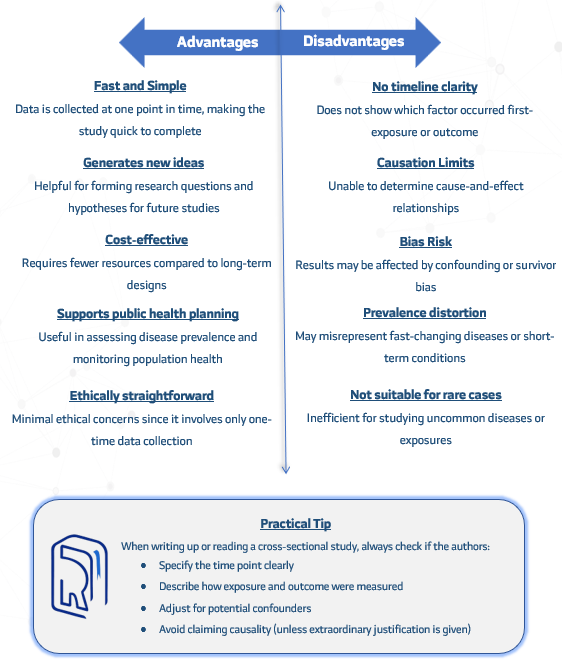
Advantages and Deisadvantages of Cross-Sectional Studies

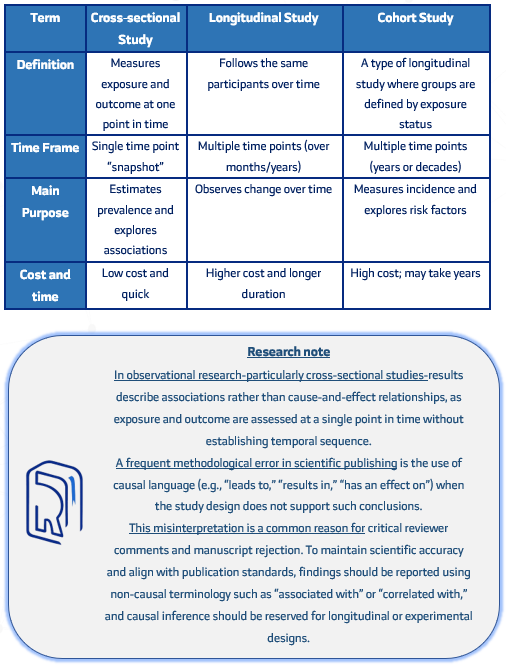
Cross-Sectional vs Longitudinal vs Cohort Studies

Examples of Cross-Sectional Studies in the Literature

A study titled “Associations between socio-demographic factors, social functioning, and sleep quality among GERD patients in Syria” used a cross-sectional design with 261 participants in Syria to measure symptom severity, social functioning (via SFQ), and sleep quality (via PSQI) simultaneously. This study found that more severe GERD symptoms correlated with poorer social functioning and worse sleep quality. It also highlighted how financial status is linked to both social and sleep outcomes. This is a strong example of how, in one moment, multiple exposures and outcomes are captured to explore associations. Study Link.

A study of 5,374 community-dwelling older adults in Guangdong, China, estimated a falls prevalence of 11.9% and identified risk factors such as physical weakness, chronic disease, and environmental hazards. This kind of study helps public health teams identify which subgroups are most at risk and prioritise interventions. Study link.

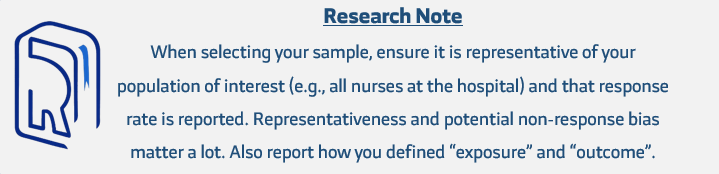
You work in a hospital and want to know how many nurses currently experience burnout and whether shift work is associated. You survey all nurses today using a validated burnout questionnaire and record their shift-patterns. This is a cross-sectional study: you measure exposure (shift work) and the outcome (burnout) at the same time. You estimate the prevalence of burnout and explore whether shift-work is associated with it. But you cannot claim shift work caused burnout; there is only an association.

Developing a Cross-Sectional Study Idea

When designing your own cross-sectional project:

  • Begin by defining your sample, setting, questionnaire(s), and country or region.
  • Check existing literature to see whether similar studies have been done in that sample or context.
  • If not, you’ve identified a new gap worth exploring.

This approach ensures your study idea is original, feasible, and contributes new knowledge, which aligns with the principle of identifying and filling “research gaps.”

Common Mistakes

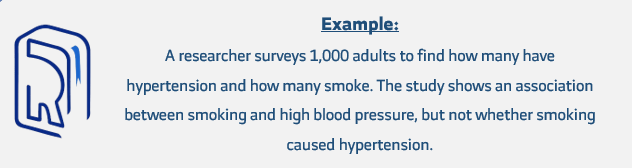
  • Claiming causality from a cross-sectional study (e.g., “smoking caused hypertension”) when the temporal sequence is unknown.
  • Ignoring confounding variables (e.g., age, gender, socioeconomic status) that may influence both exposure and outcome.
  • Using unvalidated measurement tools for exposure or outcome.
  • Failing to describe the study population, sampling method or time-point clearly.
  • Overlooking the fact that prevalence may reflect both incidence and duration, so long-duration cases may dominate.

Key Takeaways

  • A cross-sectional study measures exposure and outcome at a single point in time, a “snapshot”.
  • It’s useful for estimating prevalence and exploring associations, especially in medical research and public health.
  • It is not designed to determine causality or temporal order.
  • Strengths include speed, cost-effectiveness and applicability in early-stage research.
  • Weaknesses include limitations in inference and potential bias.

References

  1. Mahfoud, A., Jalal Eldin, A., Hmidoush, A., Abou Kheir, F., Almansour, S., Zakarya Marzouk, Z., Yacoub, P., Layton, G. R., Antoun, I., & Zakkar, M. (2025). Investigating The Impact of Syrian Conflict on Women’s Education, Mental Health, and Rights: a Cross-Sectional Study.BMC women’s health, 25(1), 551. Link.
  2. Wang X, Cheng Z. Cross-Sectional Studies: Strengths, Weaknesses, and Recommendations. Chest. 2020 Jul;158(1S):S65-S71. Link.
  3. Setia M. S. (2016). Methodology Series Module 3: Cross-sectional Studies. Indian journal of dermatology, 61(3), 261–264.
  4. Ataya, J., Sharkatli, J., Almawaz, M. Y., Wahbeh, T., Alsarhan, A., Kadri, S., Mangal, Y., Alawad, R., Hmidoush, A., Alashkar, S., & Zarzar, M. (2025). Associations between socio-demographic factors, social functioning, and sleep quality among GERD patients in Syria: a cross-sectional study. BMC gastroenterology, 25(1), 647. link.
  5. Lin, X. Z., Meng, R. L., Peng, D. D., Li, C., Zheng, X. Y., Xu, H. F., Xu, X. J., & Lin, L. F. (2022). Cross-sectional study on prevalence and risk factors for falls among the elderly in communities of Guangdong province, China. BMJ open, 12(11), e062257.

Authorship and Contributions

The following section acknowledges the individuals who contributed to the authorship, editing, translation, and preparation of this article, ensuring its academic integrity and clarity.

Ali Hmidoush Photo Formal

Dr. Ali Hmidoush

Author

M.D. and Medical Researcher; Director of Website & SEO Department at ResRef.

Screenshot_20260520_130720_ChatGPT

Dr. Ibrahim Antoun

Editor

University of Leicester, Leicester (United Kingdom of Great Britain & Northern Ireland), FESC Member, EHRA Member.

Dr. Taha Al khayrat

Dr. Taha Al Khayrat

Translator & Formatter

A fifth-year medical student contributes to the Educational and Web departments at ResRef.

Facebook
Telegram
LinkedIn
Email

Leave a Comment

Your email address will not be published. Required fields are marked *

Realted Articles

Cross-sectional Studies

Understanding Cross-Sectional Studies

In medical research, cross-sectional studies provide a quick and powerful way to understand what is happening in the present. They help researchers capture a snapshot in time, measuring both exposure and outcome simultaneously.

Read More »
Scroll to Top