



Overview
Designing a cross-sectional study requires careful planning to capture a clear and reliable “snapshot” of a population at a single point in time. This article provides a step-by-step guide to building such a study—from defining the target population and choosing an appropriate sampling method, to developing and validating questionnaires, and ensuring data quality. It explains how to distinguish between exposure and outcome, address the limitation of temporal ambiguity, and avoid common design pitfalls. By combining methodological rigor with practical advice, this guide helps researchers create cross-sectional studies that are credible, reproducible, and valuable for evidence-based medicine and public health research.
Defining the Study Population and Sampling
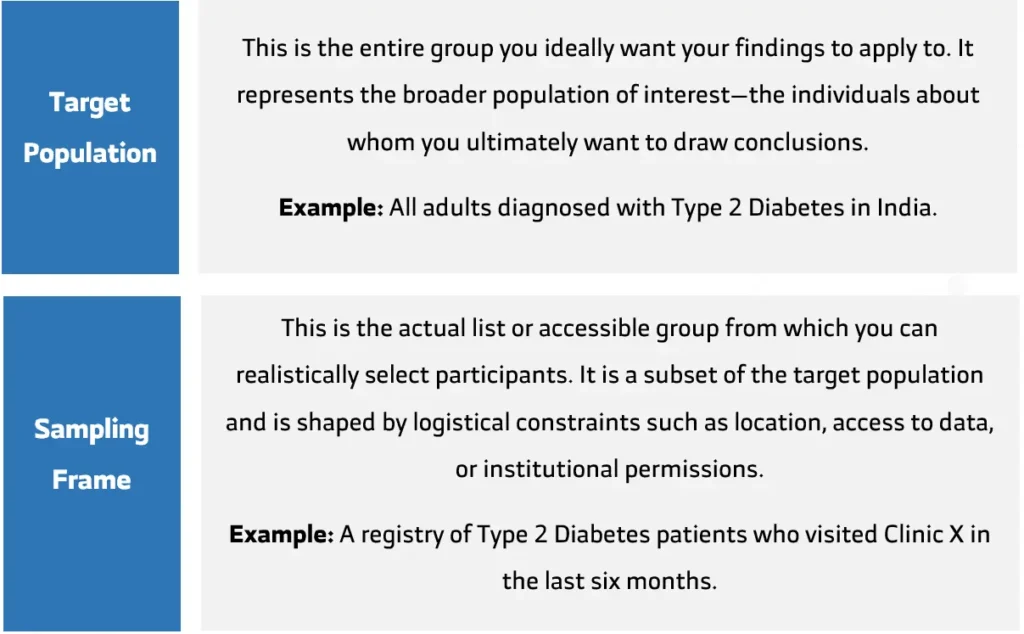
Before you design your questionnaire or plan your analysis, you must answer two foundational questions:
This step determines the quality, representativeness, and generalizability of your entire cross-sectional study—making it one of the most critical phases of research design.
Researchers often confuse these two terms, but they serve very different purposes in study design
Your goal is to ensure that your sampling frame resembles your target population as closely as possible. The greater the similarity, the more confidently you can generalize your study findings.
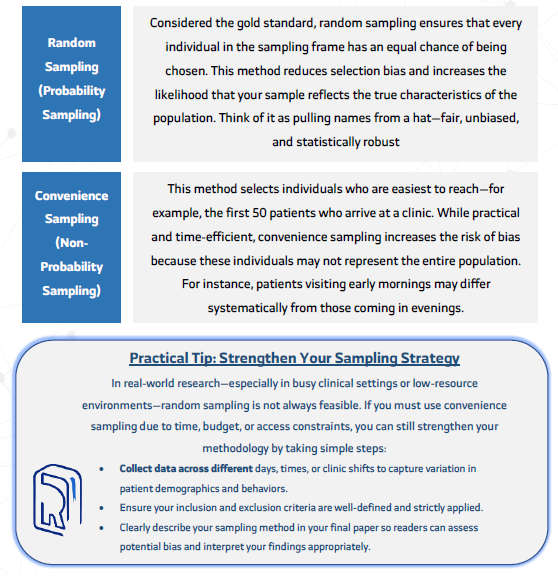
After identifying your sampling frame, the next step is deciding how to select participants.
Transparent and thoughtful sampling increases the credibility of your study and helps readers understand the context and limitations of your research
For further information about the Hierarchy of Evidence please visit our third article “From Idea to Design: A Simple Guide to Choosing Your Research Methodology.”
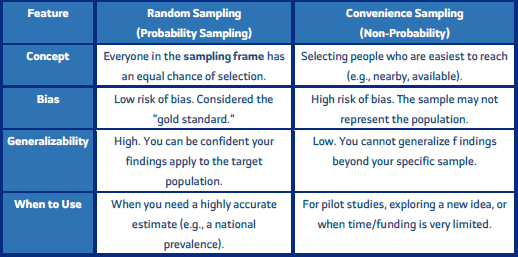
Here is a quick comparison to help you choose your sampling method:
Developing the Questionnaire
- In a cross-sectional study, your “camera” is your data collection tool, usually a questionnaire or survey.
- If your questionnaire is bad, your “snapshot” will be blurry.
- You have two options when it comes to building your data collection tool:
Use an existing validated questionnaire: Many medical questionnaires have already been tested and validated. If you choose this option, your first stop should be the data base at our website ResRef, where you will find a growing collection of validated questionnaires and practical articles explaining how and when to use each tool.
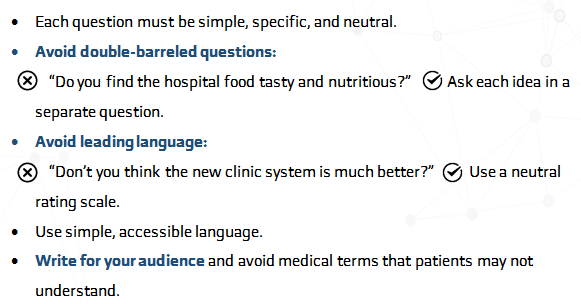
Create your own questionnaire based on your study goal: If no validated tool fits your purpose, you may need to create one. In this case, make sure to follow essential principles of clarity, neutrality, and specificity.

When creating your own items, keep the following points in mind (summarized from our main guidelines):
For full details on how to construct high-quality survey questions, see our dedicated article The Comprehensive Guide to Designing Effective Research Questionnaires, which explains advanced tips and examples step by step.
This is a step many people skip, and it’s a huge mistake!
Pilot testing means you “test drive” your questionnaire on a small group (5-10 people) before you start your real study.
Ask your pilot group:
- “Was any question confusing?”
- “Did you feel any options were missing?”
- “How long did it take?”
This helps you find and fix blurry, confusing, or biased questions before they ruin your data analysis.
Defining Variables: The “snapshot” challenge
- In cross-sectional studies, clearly defining variables is one of the most crucial steps in the study design.
- Since these studies collect data at a single point in time, researchers must precisely determine what is being measured and recognize the limits of the conclusions that can be drawn.
- Cross-sectional studies provide a “snapshot” of a population, meaning all variables are measured at the same moment.
- Both the exposure (for example, smoking, sleep duration, or physical activity) and the outcome (such as anxiety levels, blood pressure, or exam performance) are assessed simultaneously
- Suppose you conduct a study involving 200 medical students. Your questionnaire includes:
Exposure: “How many hours do you sleep per night?”
Outcome: “What is your average exam score?” - After analyzing the data, you find that students who report fewer hours of sleep tend to have lower exam scores. Although this relationship appears clear, interpreting it requires caution.
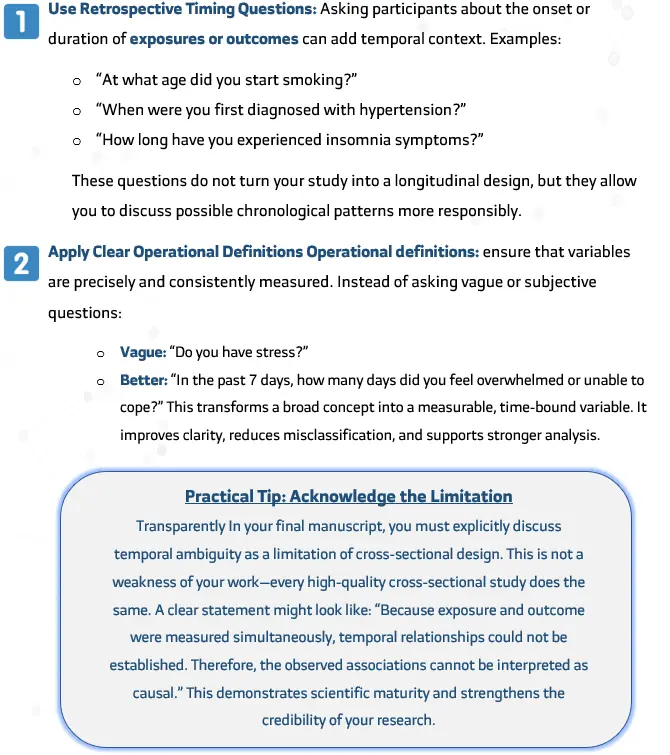
- Because the exposure and outcome were measured at the same time, the temporal order between them cannot be determined. This issue is known as temporal ambiguity, meaning it is unclear which event occurred first. As a result, the study can identify an association, but it cannot establish causation.
Cross-sectional studies cannot fully resolve temporal relationships, but you can design your questionnaire to provide stronger contextual clues:
Ensuring Validity and Reliability
Even the most beautifully designed cross-sectional study fails if the data you collect are inaccurate or inconsistent. That’s why validity and reliability form the backbone of high-quality research.
Validity: Are You Measuring What Yiu Think You Are Measuring?
- Validity refers to the accuracy of your measurement tool. In simple terms, does your instrument actually capture the concept it claims to measure?
- For example:
- A depression scale should accurately detect depressive symptoms—not anxiety, stress, or general mood.
- A dietary recall form should measure food intake—not food knowledge.
- If your tool isn’t valid, your results will be misleading, no matter how large your sample is.
Reliability: Would You Get the Same Results Again?
- Reliability is all about consistency. If the same participant completes your questionnaire twice (under the same conditions), would their answers be similar?
- If different data collectors take a measurement, will they obtain comparable results?
- Reliability ensures that your measurement tool performs predictably—not randomly.
Using Validated Measurments Instruments
The easiest way to guarantee both validity and reliability is to use instruments that have already undergone formal validation
Think of it this way:
- A validated questionnaire is like a standard, calibrated blood pressure cuff.
- You don’t need to reinvent the wheel. You simply use a tool proven to work.
- Validated instruments exist for most common research variables, including: Depression (PHQ-9), Stress (PSS), Sleep quality (PSQI), Pain intensity (VAS or NRS), Quality of life (SF-36)
Using these tools enhances credibility, a lows comparison with other studies, and strengthens the scientific integrity of your work. By accessing our platform ResRef, you can easily explore a wide range of validated questionnaires and select the most appropriate instrument for your study objectives.
If your research involves multiple data collectors—or even a single researcher interacting with many participants—standardization becomes essential.
Here’s how to do it:
- Create a clear Standard Operating Procedure (SOP): This ensures every team member follows the exact same steps.
- Train all data collectors in neutral questioning: The way a question is asked can subtly influence participants’ answers.
- Standardize measurement techniques: Whether it’s taking blood pressure, measuring height, or recording responses, everyone must follow identical procedures.
Without standardization, even a validated instrument can produce unreliable data.
That’s why the foundation of a strong cross-sectional study lies in:
- Clear definitions.
- Well-designed questionnaire.
- Use of validated tools.
Consistent data collection investing effort at this stage ensures your findings truly reflect reality and contribute to evidence-based medicine.
Key Takaways
- A cross-sectional study is a “snapshot” in time.
- It’s excellent for measuring prevalence (how common something is).
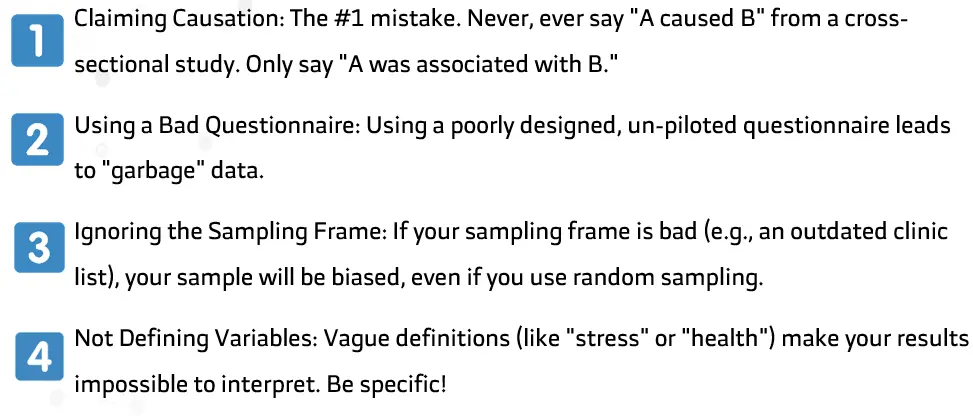
- Its biggest limitation is temporal ambiguity: you cannot determine cause and effect.
- Success depends on three things:
- A good sampling strategy.
- A clear, well-designed questionnaire.
- Clear operational definitions for all variables.
- Always pilot test your tools and use validated instruments when possible.
References
- Wang, X., & Cheng, Z. (2020). Cross-Sectional Studies: Strengths, Weaknesses, and Recommendations. Chest, 158(1S), S65-S71. (PMID: 32658654).
- Khadka, J., et al. (2023). Designing and validating a research questionnaire – Part 1. Journal of the Nepal Medical Association, 61(268), 1070-1076. (PMID: 38294246).
- Ali, Z., & Bano, F. (2024). Crafting an effective questionnaire: An essential prerequisite of engaging surveys. National Journal of Community Medicine, 15(05), 373-377.
- Andrade, C. (2020). Sampling: How to select participants in my research study? Indian Journal of Psychological Medicine, 42(2), 199-201. (PMID: 32317804).
- Al-Ghaanim, L. A., & Al-Baho, M. S. (2024). Psychometric Validation and Reliability of the 9-Item Shared Decision-Making Questionnaire: A Systematic Review. Medical Science Monitor, 30, e943362. (PMID: 39343336).
Authorship and Contributions
The following section acknowledges the individuals who contributed to the authorship, editing, translation, and preparation of this article, ensuring its academic integrity and clarity.
Dr. Ali Hmidoush
Author
M.D. and Medical Researcher; Director of Website & SEO Department at ResRef.
Dr. Ali Hmidoush
Author

Dr. Ibrahim Antoun
Editor
University of Leicester, Leicester (United Kingdom of Great Britain & Northern Ireland), FESC Member, EHRA Member.
Dr. Ibrahim Antoun
Editor

Dr. Taha Al Khayrat
Translator & Formatter
A fifth-year medical student contributes to the Educational and Web departments at ResRef.
Dr. Taha Al Khayrat
Translator & Formatter